
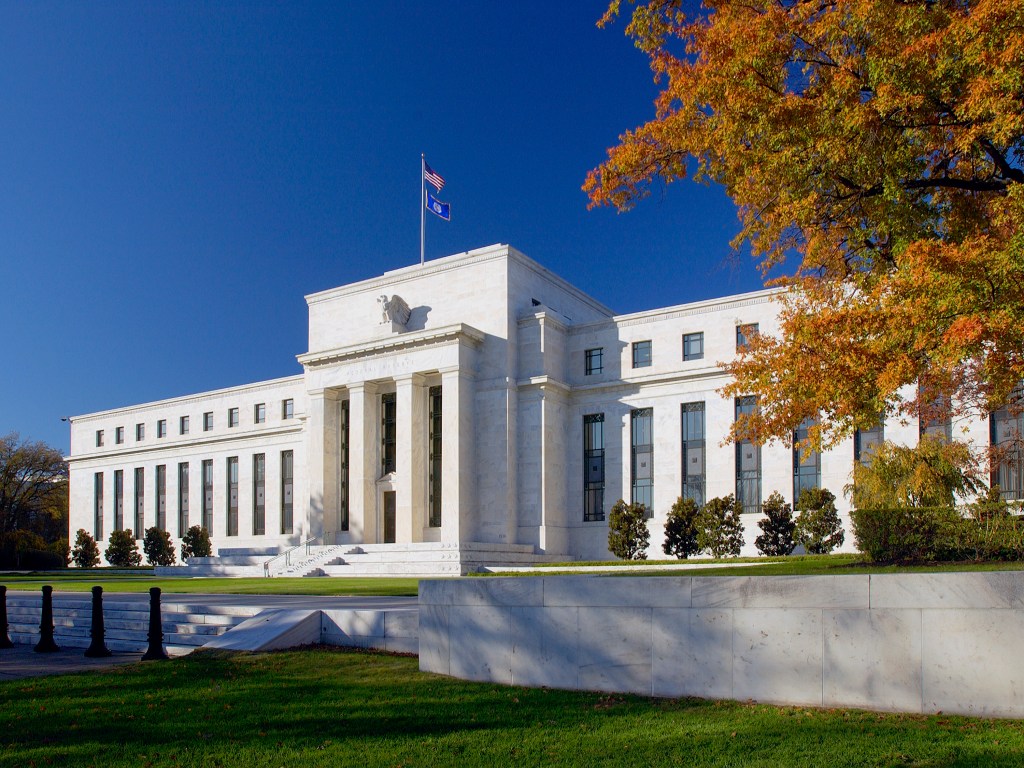
Marriner S. Eccles Building, Washington, D.C. File photo: Federal Reserve Board (public domain).
July’s inflation debate is becoming a question of whether the economy needs more tightening.
Market Analysis · Information available as of July 29, 2026, U.S. Eastern Time
The Federal Reserve left its benchmark interest-rate range at 3.50%–3.75% on July 29. The decision exposed a clear division: three of the twelve voting officials wanted borrowing costs to rise immediately.
Beth Hammack, Neel Kashkari and Lorie Logan preferred a quarter-percentage-point increase. The 9–3 vote therefore revealed a disagreement over whether existing policy was doing enough to contain inflation. The Fed’s statement also pointed to energy-related supply shocks and uncertainty surrounding the Middle East conflict. Federal Reserve decision
Three dissents cannot tell investors what the next meeting will deliver. They do establish that the case for another increase has support inside the committee. That matters for anyone valuing an asset on the assumption that borrowing costs will soon fall.
A softer inflation report did not settle the question
The strongest recent evidence for patience arrived on July 14. Consumer prices fell 0.4% in June, after seasonal adjustment, while annual headline inflation slowed to 3.5%. Core inflation, which excludes food and energy, was unchanged for the month and stood at 2.6% over the year.
The composition of that improvement matters. Energy prices dropped 5.7% in June, contributing more than any other category to the overall decline. Yet energy remained 15.7% more expensive than a year earlier. The report showed meaningful relief alongside the lingering effects of the earlier shock. BLS June CPI release
There is also a measurement distinction: the Fed’s 2% inflation objective refers to the Personal Consumption Expenditures price index, rather than CPI. A favorable CPI reading is useful evidence, but it does not itself establish that the Fed has met its target. Federal Reserve inflation framework
At his July 29 press conference, Chair Kevin Warsh emphasized that one encouraging month could not resolve years of inflation above target. He also indicated that the June CPI report had not been a major reason for the decision to hold rates. Press conference, pages 1 and 6
Oil made the outlook conditional
Earlier in July, there was a plausible route to further energy relief. The Energy Information Administration’s July 7 outlook incorporated increased shipping through the Strait of Hormuz following the June 18 agreement between the United States and Iran. It forecast a recovery in oil production and trade flows, with Brent crude averaging $74 a barrel in the third quarter, down $27 from its previous forecast. EIA July outlook
That figure was a forecast built on improving supply conditions. It was never a guarantee of what consumers would pay later in the summer.
By July 29, renewed fighting with Iran had unsettled that picture. Brent crude rose 7.3% to settle at $88.09 a barrel that day, according to the Associated Press. July 29 market report
For monetary policy, the distinction is crucial. A rate increase cannot reopen a shipping route. Its purpose would be to restrain demand and reduce the risk that higher costs spread through the economy. The difficulty is judging whether an energy shock will fade before it becomes a broader inflation problem.
The June improvement makes patience defensible. The dependence on unstable supply conditions makes confidence harder to justify.
Waiting and tightening both carry risks
The labor market gave policymakers another reason to be careful. The employment report available before the meeting showed 57,000 additional payroll jobs in June and an unemployment rate of 4.2%. The same release revised April and May payroll gains downward. BLS June employment release
Those figures offer a more restrained picture than an economy expanding without friction. They also do not, on their own, establish a recession.
The policy tradeoff follows from that mixed evidence. Tightening too aggressively could weaken hiring and investment while doing little to repair energy supply. Waiting too long could allow persistent price increases to become harder to reverse.
The dissenters favored an immediate increase. The majority chose to maintain the existing rate. Neither decision removes the need to judge how inflation and employment evolve together.
The bond market can tighten before the Fed does
Warsh highlighted a development that helps explain the hold: both nominal and real Treasury yields had risen materially since the previous meeting. Market financing conditions had become tighter even though the policy rate had remained unchanged. Press conference, pages 2–5
The curve also moved in different directions on July 29: the two-year Treasury yield slipped to 4.24% from 4.26%, while the ten-year rose to 4.68% from 4.61%, according to the same AP report. Treasury market reaction
A fixed-rate bond’s cash payments do not increase simply because investors now demand a higher yield. Its market price generally falls instead. Investors who need to sell before maturity can therefore experience losses even on government debt. SEC explanation of interest-rate risk
For stocks, higher discount rates reduce the present value of expected future cash flows, holding those cash flows constant. Earnings can still grow while the valuation investors assign to them falls. Federal Reserve discussion of asset valuation
This is why an unchanged Fed rate offers limited reassurance on its own. Investors must assess the rates markets demand across different maturities, alongside corporate earnings and risk premiums. A Treasury selloff also has several possible explanations; it should not automatically be read as a pure forecast of higher inflation.
What would decide the next move
The evidence to watch now is whether lower energy costs persist, whether underlying inflation continues to improve, and whether hiring holds up. The next CPI release, covering July, is scheduled for August 12. Its results are still unknown as of this analysis. BLS release schedule
If supply conditions improve and broader inflation keeps easing, the argument for maintaining rates becomes stronger. If price pressure returns while employment remains resilient, the argument for an increase gains weight. If hiring weakens sharply, the committee faces a more difficult balance.
The clearest reading of July’s decision is that the Fed has bought more time to assess those risks. Investors should use that time to examine how much of their expected return depends on cheaper money arriving soon. The three votes for an increase make that assumption harder to take for granted.

